>The results of this postmortem cohort study demonstrated that COVID-19 infection could cause axon injuries and microvasculopathy in olfactory tissue. Overall, patients with smell alterations had more severe olfactory pathology than those with intact smell.
In layman's terms, people who reported loss of smell had damage to the nerves and blood vessels in their nose. That conclusion, and the paper's actual title, is quite a bit more mundane and less alarmist than the submitted title here ("Covid Smell Loss Linked to Damage in Brain").
> In the region of *olfactory bulb and olfactory tract*, COVID-19 infection was associated with axon pathology and microvasculopathy, particularly in patients with smell alterations; the olfactory pathology did not result from direct viral injury and may be associated with local inflammation.
That is not the same as "nerves and blood vessels in their nose".
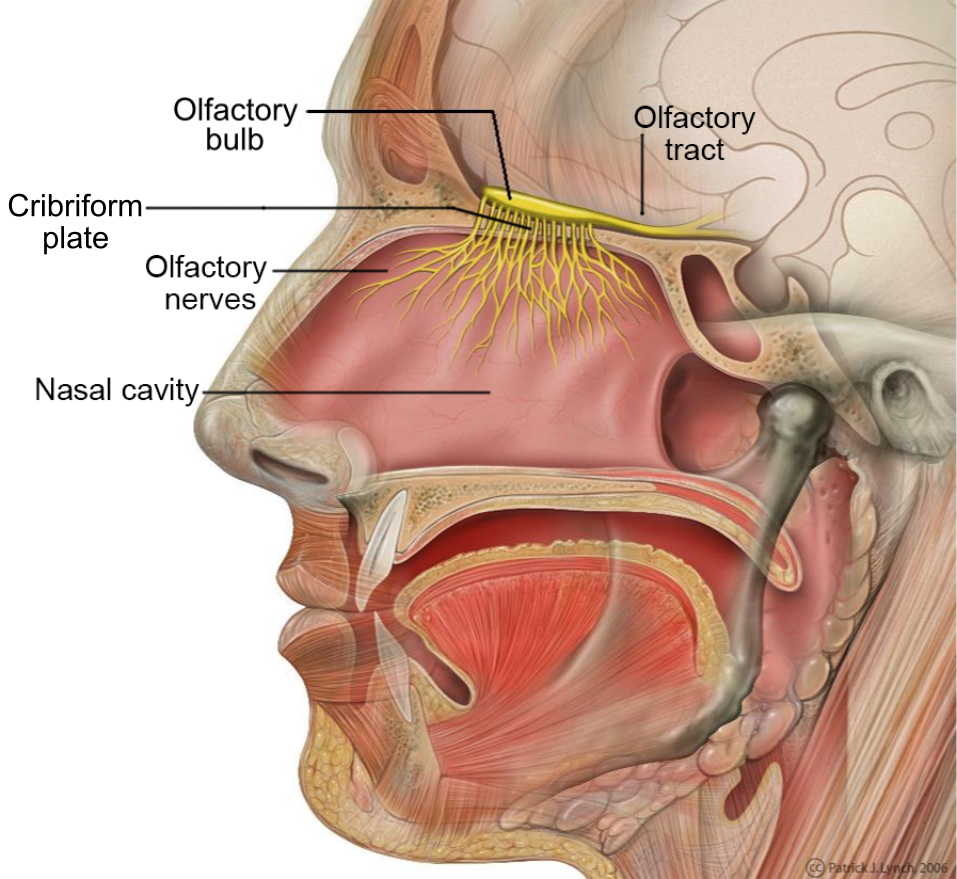
For those curious here's an image of where the olfactory bulb is [0]. It's pretty clear that any "layman" would define this as "in the brain". I don't think this is alarmist, rather that you are misunderstanding where the region effected is.
yes and no. it is somewhat alarmist as the olfactory bulb is anatomically part of the brain and is responsible for initial transmission of the olfactory signals for further processing in the amygdala. it essentially completes the circuit between the olfactory neurons and the amygdala. if the research shows that the amygdala has been damaged, then i'd feel much more comfortable with alarmist "brain damage" headline.
even so, the damage itself is devastating. my daughter and wife both suffer from covid-related parosmia. my daughter has dealt with it for ~18 months now and has given up hope of ever getting to enjoy tastes she once loved.
I'm really sorry for your family. This is part of the reason I don't even want to catch Covid.
In 2020 my sister lost her sense of smell t Covid, and it seems to have permanently altered her sense of taste. What else but damage to the brain could do that?
To this day food she used to love have been corrupted. She can't describe it, but the closest she has articulated to me is that certain things things "taste the way cigarettes smell." As a result, she has had trouble eating and has lost a lot of weight (not in the way you want to lose weight).
I get really upset when people dismiss long covid as some sort of hysteria. Even if that were true, the impacts are real, and it's not a joke or something to be minimized and dismissed.
This paper describes damage to the axons in the olfactory bulb and tract. While their olfactory neurons have their cell bodies in the epithelial, their axons extend through the tract into the bulb. Thus the damage appears to not be to receptors or support cells in the epithalia / nose but to axons in bulb / brain.
> Thus the damage appears to not be to receptors or support cells in the epithalia / nose but to axons in bulb / brain.
No. From the paper:
> Consistent with findings reported by other groups,16,19 this study also did not find evidence of viral infection in olfactory bulb from most patients with COVID-19. Therefore, the axon and microvascular pathology in olfactory bulb and olfactory tract were most likely not caused by direct viral injury.
Moreover:
> this study did not find a strong association between olfactory endothelial injury and disease severity, suggesting that local inflammation in the upper respiratory tract may be sufficient to cause endothelial and axonal damage in the olfactory pathway.
I'm not an expert in the microanatomy of the olfactory pathway so I'm not going to debate the location of the samples, but the authors are explicit that your interpretation is incorrect. It's not the neurons themselves, it's some inflammatory process external to the neurons that is causing damage.
This has clear implications for the level of panic people are bringing to this conversation. A virus that can infect neurons (e.g. rabies, herpes) can cause damage by moving within the nerves themselves. This virus does not appear to do that, and instead causes local inflammation that indirectly influences the neurons.
Debating whether or not this is "brain damage" is academic; most people in this conversation are leaping to wild conclusions about the virus "infecting the brain". This is not supported.
> the authors are explicit that your interpretation is incorrect. It's not the neurons themselves, it's some inflammatory process external to the neurons that is causing damage.
I never claimed that infection of the neurons caused the damage. That is a strawman you created.
What I said is that there was damage to axons in the olfactory bulb, which is part of the brain.
If there are people leaping to wild conclusions, why not respond to them rather than trying to foist their views off on me?
Regardless of what you want, you will almost certainly catch a SARS-CoV-2 infection eventually (and perhaps multiple times). The virus is endemic and highly contagious so avoiding it is impractical. You might have already been infected without knowing it because many carriers never develop clinical COVID-19 symptoms. Fortunately the vaccines and other treatments are pretty effective at preventing deaths.
There are a populations of experts that promulgate that view. There is another population of experts which strongly disagree with the assessment of inevitability.
I gravitate towards those that say something can be done; that we have both the science and the ability to do it, though I'd say we do have a lot of people with a lot of power that want to tell us to give up on the precautionary principle.
Which specific experts claim that it will be feasible to avoid a highly contagious respiratory virus for decades? That seems implausible based on what we now about viral transmission. The virus will be around forever, and all it needs is one mistake or a bit of bad luck.
So what? That's a total non sequitur. The measles vaccine is highly effective at preventing infection and transmission. That situation doesn't obtain with SARS-CoV-2. The vaccines are pretty good at preventing deaths but they have only a marginal and temporary effect on preventing infection and transmission. For the foreseeable future, every time you interact with another person (or certain other mammal species) there is a significant risk they will transmit the virus to you. That is our reality and wishful thinking won't change it.
Instead of trying to avoid infection and most likely failing, a more productive approach is to focus on reducing the risks of a bad outcome when you inevitably do get infected. For most people that means getting vaccinated plus resolving any major risk factor conditions such as obesity, type-2 diabetes, and hypovitaminosis D.
And you didn't answer the question. Which specific "experts" claim it will be possible to avoid infection?
Neither of those links support your claim. They don't state that it will be possible to avoid infection. Certain non-pharmaceutical interventions can potentially delay exposure for certain individuals, but unless you hide in a sterile bubble you will be exposed.
And the so-called "People's CDC" isn't even a serious scientific or medical group. Unlike the real CDC, they're not doing any original research or useful analysis. It's merely a political advocacy group. There's nothing wrong with political advocacy but don't confuse it with actual science.
SARS-CoV-2 is only "novel" in the sense that no one had acquired immunity to it before 2019. But otherwise it's very similar to other betacoronaviruses such as HCoV-OC43.
You may want to try some empathy. Losing one of the primary senses is certainly a devastating loss, even though it is not mortal, as you point out. Death is not the only result that qualifies as devastating.
> That is not the same as "nerves and blood vessels in their nose".
The words literally mean "nerves and blood vessels in the nose". The quoted text also tells you that the observed pathology is not from direct viral infection.
Saying that "covid leads to brain damage" because the olfactory nerves are connected to the brain is an unsupported leap, and it's why the title of the paper doesn't say this. The title of this article is purposely sensational, and really needs to be changed.
A better, more accurate title would be: "covid smell loss due to inflammation in the olfactory epithelia".
>A better, more accurate title would be: "covid smell loss do to inflammation in the olfactory bulb".
I'm a layperson. Like many laypeople, I would have no idea what the "olfactory bulb" was if I saw it in a headline, but the Wikipedia page for it starts with "The olfactory bulb (Latin: bulbus olfactorius) is a neural structure of the vertebrate forebrain...". It certainly sounds like "brain" is a fair and accurate summary.
If you're a "layperson" and resorting to reading wikipedia, then you really have no basis to draw any conclusion. But you're extremely willing to jump to scary conclusions, and disregard people who understand the paper and terminology and tell you that your conclusion is wrong.
It's a medical paper. It isn't written for non-practitioners, and if you don't understand it, the best thing to do is not to speculate, but to reserve judgment.
I don't know what your point is considering I never speculated about anything in these comments. Ironically enough, you seem to be speculating about what people might speculate about when they see that headline.
> I'm a layperson. Like many laypeople, I would have no idea what the "olfactory bulb" was if I saw it in a headline...It certainly sounds like "brain" is a fair and accurate summary.
It is funny how something starts to seem more like speculation when you conveniently throw an ellipsis over the part in which I cite the source where the "speculation" came from.
It’s probably a problem of non-specificity: if you say “the brain” some folks will consider just the prefrontal cortex, where thought happens. Olfactory nerves, where the smell happens, is a different enough concept that it might not align with the reader’s preconceptions of “the brain.”
I just cannot tell if you are serious. If someone cuts themselves a bit deep into the skin, it's probably that a nerve will be affected. Would you describe such an injury as "brain damage"? I am trying to understand your thought process.
That was a position before the lockdowns even happened. There's nothing new about that thought.
Some local governments even felt strongly enough about that to go against the majority and have the laxest restrictions they could, or even prevent cities and counties from enforcing stronger measures than the state.
It remains to be seen how that plays out in the end, though. History books in a few decades are going to be very interesting.
Do we? It is arguable that much of what people are referring to as a 'lockdown' was voluntary and would have happened in any case. Especially early on, there was surprisingly little variation between jurisdictions that formalized it with regulation, and ones that did not.
This research on the neurological damaged caused by covid suggests that we objectively don't yet understand the long term impacts of covid infection. Given that something like 40% of the US has contracted covid at least once (per CDC), even a small effect on the age-incidence of heart attacks or strokes could cause major social and economic problems in 20+ years.
Mine does too. Not in the way it did when I "had covid" though... that was like a blackout.
(My covid experience: all I did was lose my smell for 2-3 days. No cough, fever, brain fog, or other issues. Felt fine. Continued to be outdoors, walked/biked the entire week. Avoided anyone/everyone at any visual distance. Positive PCR test.)
I had Covid-related anosmia for a few days, and it was very different from just being stuffed up and unable to smell/taste like with a regular cold. I could stand over e.g. a fire, and instead of smelling smoke, I had a sensation of smelling "nothingness."
I was in the shower, squirted shampoo, lathered, and it hit me. Something was missing. I couldn't smell anything.
I went so far as to take the bottle and squeeze air from it into my nose. I could feel the puff, but that was it.
It was actually a little bit jarring. It was complete loss for a couple of days and got progressively better until back to normal a couple of weeks later.
Since there is no money in the other 3 we'll continue forever to believe those are not the same as COVID's pathway. But great comment - you're probably right.
..and by extension those who gained their senses back experienced a ...repair to the nerves and blood vessels in their nose? Is that any different that nerve repair in the brain?
so basically in this case, they (OP, maybe the authors too) are considering the olfactory tissue "in the nose" to be part of the brain?
thats..... extremely ambiguous and explains why my understanding of this COVID phenomena has gone full circle, like where's the limit then? nerves that aren't a part of the head? or would they consider losing a sense of touch in your knee from a dull nerve to be "damage in the brain" as well.
The neurons contributing to your sense of smell as well as your optic nerve are more or less considered part of your brain. Loss of smell is more or less a canary.
> Each neuron in your brain has one long cable that snakes away from the main part of the cell. This cable, several times thinner than a human hair, is called an axon, and it is where electrical impulses from the neuron travel away to be received by other neurons.
When they get a nose job the region of the body that contains the olfactory bulb is not touched at all since that is in the brain, not in the nose. I posted this image in another comment [0], but it seems there's a misunderstanding of anatomy here.
> but it seems there's a misunderstanding of anatomy here
yes, I agree and it also is worth mentioning that it is being communicated poorly in many forums where people also misunderstand this
olfactory = smell
people, myself included, think there are filaments in our nose (the parts we can see and stick our fingers into) that this is referring to. great opportunity for more anatomically minded people to explain this better.
> people, myself included, think there are filaments in our nose (the parts we can see and stick our fingers into) that this is referring to.
The confusion may be due to the fact that olfactory sensory nerves have their cell bodies (with the smell receptors on cillia) in the nose. Like many peripheral nerve cells, these cells also extend directly into the brian via their axons. In this case, those axons extend via the olfactory tract into the olfactory bulb in the brain. These areas (tract and bulb) are where the paper indicates axon damage was found.
Cranial nerves are often considered part of the brain. That includes olfactory n. (CN I).
More precisely, this paper addresses damage to the olfactory bulb as well as the olfactory nerve. That's not in the nose - that's part of the brain proper, without any ambiguity at all.
okay, I understand, when people think brain damage, they aren't thinking about sensory inputs, they are thinking about thinking function. I can see how the line would be blurred to someone that cares. but maybe this is an indication of further damage to be investigated.
I had a weird one. Got covid and my taste for alcohol got ...corrupted. For the first 200ms of a sip of wine or beer it tasted normally, and then a wave of extremely bitter aftertaste would come and drown all the other tastes. It lasted a few weeks and then it fixed itself in the course of one day. It did coincide with me taking a few zinc pills as someone told me taste anomalies are sometimes caused by zinc deficiencies.
I had a complete loss of my sense of smell, which I first noticed when I put my nose into a bottle of softener and smelled nothing.
The first scents like parfume came back after two weeks. Real stench was away for months and came back with parosmia. Sounds not too bad if you can't smell stench but on the other side: making new friends with dogshit under your sole is not easy.
I heard similar from people. I did not get corruption but my sense od smell came back after 4-5 months. In some ways, I miss it, depraved of one of the earthly pleasures :P
Caught COVID twice before the vaccines were available. First bout was the first time in my life that I was so physically ill that I barely had the strength to make it to the restroom. Second time is when I partially lost my sense of smell... and honestly, I'd rather go through 10 of the first type than have ever gone through the second.
Now, I get to deal with the fun of not being able to taste / smell certain things AT ALL, phantom smells like today when it seems like my office is full of diesel fumes, and heightened tastes of other things due to the muting of some of those tastes. I've finally recovered from the brain fog and the narcolepsy, but I also know that my energy levels will probably never be where they used to be unless I train far harder than I'm willing to given my lifestyle.
Oranges? Loved them. Can't stand them. I have zero ability to taste the sweet and sour citrus component.
Peppers? Loved them. Can now only tolerate them if they are VERY cooked down and not a main component of a dish.
Ground beef? I can tolerate in patty or loaf form. Not ground for some reason. It smells exactly the same going in one end and out the other... like canned dog food.
It's terrible. I used to smoke a lot of cigars years ago, and spend my evenings on google hangouts educating people about the industry and the brands and the hobby of collecting them. I brought that level waaaaaaaaay down to maybe one or two a month, smoking them in the evenings to unwind and relax. They no longer bring me joy because I spend my time trying to figure out what I can still taste out of brands that should be relatively consistent. So now it feels like I have this watch spring inside me that is just wound up with no way to release it, and the thing that used to give me peace now just irks my nerves. I've described this to people and they'll say "oh, just do some yoga or meditation or something"... when the entire point of the original exercise was to just sit there, focus on something I enjoyed, and let the world pass by. Ugh.
Oh, and the best part? Twice, my kids brought it home from school. "But kids don't die from it, so why vaccinate them?"
Because that's why. They're little disease vectors for every other thing on the planet, so what makes anyone think they're immune from this?
I've heard from multiple people now that a dose of LSD brought their smell back. Reasoning theoretically, any 'neural annealing'[1] or 'neuroplasticity-promoting' activity may have the same effect. Try engaging in sensuous, pleasing activities (meditation, music, spa revery, gentle play in nature) where you temporarily lose yourself and let your brain discover new connections.
In other words, if you don't take psychedelics, try cultivating vibes like [2] or [3] in your life, or whatever your version of that looks like. Certain films are also a good pointer, like [4] and [5].
Yup, I know someone who had COVID and it completely broke/made their sense of smell of certain foods disappear, and later it was "repaired" right away after taking a single dose of LSD. That person had no idea of this, and found other anecdotes posted online, so it wasn't a placebo. The way how I imagined this worked is that COVID weakened/malformed some neural connections responsible for remembering these smells but LSD fired these temporarily. So I recommended to that person to regularly pay attention to these smells so the connection doesn't fade over time. Few months later it was still in full effect - I know it's highly anecdotal and not very scientific reasoning but still it was a nice unexpected side effect
Qualia Computing is fun but I'd caution against citing it as a serious academic source, since it mostly consists of abstract conjecture and untested hypotheses.
But while I'm here, let's explore fun. It could be that recovery from anosmia works like, say, nerve pain from spinal cord injury. It seems that the false feelings (burning, electric shocks, allodynia etc.) experienced by paraplegics are the result of neurons sending very different input than the brain has learned to process. Obviously LSD won't help you walk again, but e.g. exposure therapy for allodynia seems to work, probably through neuroplasticity.
Qualia Computing I'll agree contains a lot of conjecture, but I wouldn't call it untested. If anything, they tend to test it as often as they can get their hands on it!
It will get better, I promise you. Have you tried a smell training kit? I'm doing that with an almost meditation, thinking back to childhood and such with each smell. That could be helping along with just time. It's like severing a nerve, eventually it will reconnect (depending on case)
I once lost the sense of smell (anosmia) and feared it was gone forever. Later I went through a stage where my brain was getting incorrect signals: awful hydrocarbon phantasm smells came and went.
Then, one day, long after I had given up trying to do anything about it, I realized that I could smell again! My old friend was back!
Total time from loss to restoration: about 4 years.
Does oral cortisone (a.k.a. prednisone, the pill not the sprays) have any effect? [I'm fairly certain most ENT doctors would prescribe that, not as a continuing prescription, but as a test].
> Caught COVID twice before the vaccines were available.
minor detail - vaccine does little-to-nothing to decrease the transmission of COVID-19. The vaccine manufacturers details will confirm this, if you read carefully.
edit a comment snippet below is clear and well-worded so I will repeat here -- agree : The "decrease of transmission" is really only talking about "If I'm in a room with a COVID positive person, will I get sick?" and nothing about population level "decrease of spread" because there are less contagious days per person per infection.
So "little-to-nothing" is an understatement and even a fairly small percentage reduction means a lot when it applies to hundreds of millions of people. The "decrease of transmission" is really only talking about "If I'm in a room with a COVID positive person, will I get sick?" and nothing about population level "decrease of spread" because there are less contagious days per person per infection.
"We provide empirical evidence suggesting that vaccination may reduce transmission by showing that vaccination of health care workers is associated with a decrease in documented cases of Covid-19 among members of their households."
So vaccines not only provide protection against worse outcomes (including the parent commenters loss of smell), but they also reduce spread, even if just through the fact that a shorter infection means less opportunity.
Caveats: study is pre-omicron, and in a population that has a higher likelyhood of previous infection (nurses). Infection followed by vaccination leads to supposed "hybrid-immunity". These findings may not translate to those who did not get infected but were vaccinated
Vaccines reduce overall levels of disease and therefore viral transmission; that's completely false. Transmissibility of SARS‑CoV‑2 can be hard to measure since asymptomatic people can be highly infectious.
I do read carefully. The truth is in the middle. Vaccines don't prevent spread, as out establishment kept insisting to get everyone vaccinated. They do decrease spread.
Managed rationally, this means:
1) Vaccines aren't a reason to reduce other precautions, if you're worried about spread.
2) They are an important part of the solution. Being outdoors doesn't stop spread. High-filtration masks, used by untrained people, don't stop spread. Vaccines don't stop spread. Combine them? R0<<1, and we're all okay.
They do however have a large effect on the severity of the disease if you do catch it. Anecdotally at least, loss of smell is much less common amongst those vaccinated.
Not minor. The anti-mandate argument rests on this fact. One that is not in dispute among experts yet is widely ignored by policymakers and HN commenters.
What's odd that many people who tried stellate gangelion block found complete relief from smell and taste issues . So this whole "damage" issue might not be the reason for this cause
This is an interesting article. I'm going to ask my doctor about it. I had Covid in early November, 2021, and still experience some of the symptoms others have mentioned in this thread (80 percent smell back, some foods taste different, and some smells are different than pre-covid; for example, coffee smells like warm cheese to me now).
My concern is sample size of two patients for the article. Still, if it's a common procedure with low risk, it sounds interesting enough to look into.
From studying neuroscience in college, I knew that the olfactory system goes straight into the deep brain as one of the oldest evolutionary neural structures and pathways. It's likely related to how a smell can instantly evoke very deep and old memories more strongly than sight, touch, or hearing.
I caught by breath when I first heard that one of the initial signs of COVID-19 is loss of smell. I don't know what's going on in there, but it can not be good - kind of like a code insertion into the deepest kernel layers - it can make an outsized disaster.
I've been really worried about whether COVID has affected my brain. I had very mild loss of smell and flu like symptoms (I contracted COVID before the vaccine was available). I also had what felt like brain fog as well afterwards. I'm fine now, but I often spend time worrying about whether I've had a drop in cognitive functions post-COVID. I hate that it's impossible to really gauge how it affected my brain. My brain is my most important work asset (I'm a SWE) and I hate the idea of losing a few IQ points to COVID that could diminish my ability to create.
There are people with a stroke, removed tumor or other brain injuries who recover (e.g. see Simone Giertz on yourtube). Don't underestimate the ability to adapt. Maybe you lost a few points. Maybe not. Maybe you didn't even fully utilize your brain anyway and with a few tricks you easily blow past your capabilities from before covid. Just listen to a few "Huberman Lab" podcasts about cognitive function and the brain. I know worrying can be a vicious cycle. Trying to improve is the best you can do to grab yourself out of it.
> There are people with a stroke, removed tumor or other brain injuries who recover (e.g. see Simone Giertz on yourtube). Don't underestimate the ability to adapt. Maybe you lost a few points. Maybe not. Maybe you didn't even fully utilize your brain anyway and with a few tricks you easily blow past your capabilities from before covid.
Stuff like this is not helpful. Unless you've personally had brain trauma, you probably don't understand what it's like to live with constant brain fog, and to spend extra time understanding abstract concepts that used to be easy. It adds up and wastes your free time. There are no positives about it.
> I know worrying can be a vicious cycle. Trying to improve is the best you can do to grab yourself out of it.
On the other hand, this is helpful. Because worrying about something you can't change can only make it worse. What helped me personally is adjusting my expectations (and expectations of others) and just living my life day to day, trying to enjoy it as much as possible.
> you probably don't understand what it's like to live with constant brain fog, and to spend extra time understanding abstract concepts that used to be easy. It adds up and wastes your free time.
I have CFS, and the brain fog really is absolutely awful.
Just around 5 years ago, I was at the top of my game, and could accomplish in one day at work what would take a team of colleagues a week to do.
Now... gods, everything just seems to take me forever! I'll think "that'll take me an hour", and I'm still working on it days later. I keep catching myself staring at the screen like I'm in a trance, and yak shaving to avoid more complex tasks. I frequently forget what I was even doing.
It's hard to describe, but it's like my thought process has slowed to a crawl - my "inner monologue" remains normal, but everything else is just slow as hell. It's really difficult to focus on tasks. 5 years on, and I still overestimate my abilities; it just feels so alien still.
It's pretty much ruined my life, so yeah, don't underestimate brain fog.
Sorry to hear. That sounds awful (and almost a mirror of my experience after an accidental brain trauma).
That being said, we're lucky that we still can do the things we used to, albeit slower. It's only when you absolutely cannot do certain things that is really daunting.
I got a microstroke (lacunar TIA) as a result of the Astra Zeneca COVID booster (3rd vaccine I had, two others were pfizer).
You are right how people cannot imagine the impact it has on oneself. Headaches, inability to focus, head pressure, anxiety, among other things. The struggle is real, including the fear of getting a full blown stroke at any moment.
I'd try to frame the experience as a sunk cost (i.e. cannot be changed) and try not to quantify it. Instead focus your energy on developing your skills and keeping yourself healthy going forward. Easier said than done of course.
Yeah exactly. This is your life now, and worrying about any possible impact it had isn't going to change anything about the impact and how it affects you now. All you can do is move on the best you can.
You can't go through life and give up whenever a thing might not go your way. Think about a person who had a chunk of their brain removed, or lost their legs. They could sit down and feel sorry for themselves or push through and make something of it.
Also you might be experiencing some kind of medical anxiety due to media constantly bombarding you with Covid side effects 24/7. If they did the same with the Flu you would see they have very similar effects.
Same and I've seen a definite change.. I went from enjoying hands on competitive fps games to just watching dumb comedy and anything more makes me sleepy. I'm going it will get better but if not well people in the future will just pity us ... Had brain fog, lost the "drive", still good at complex problem solving but somehow feel unable to relate to it like part of me gets it and other is completely clueless and too tired to even bother
I got Covid (Delta) in November despite being vaccinated. I guess you can call it a "mild case" - I felt sick for 1-2 days, then weaker than normal for ~ ten days. But I did have complete loss of smell - interestingly enough I could taste food just fine, but I could put my nose (which wasn't clogged up or anything) into a jar of ground coffee and wouldn't be able to smell a thing. No cognitive impairment though. And, if you read the article, it doesn't say anything about "brain damage" either, just "Olfactory Tissue Degeneration and Microvasculopathy" (which could be roughly translated as "nose damage", I guess) - no idea why it was submitted with this title.
I'm just going to add some anecdata for people to weight when they are taking this decision: The covid AZ booster gave me an ischemic stroke (Lacunar TIA, detected by MRI, confirmed by my Neurologist).
My GP got only one Pfizer vaccine and got myocarditis. She decided not to get any subsequent vaccines.
There's plenty of anecdata cases of people having bad significant reactions to the vaccines all over the internet. As they say, the probabilities are low, but if you happen to be like me, who believed in the statistics and get shafted... well probabilities are meaningless to me now.
I did not draw anything. My vascular Neurologist gave me the diagnostic after looking at my MRI, A LOT of tests, including blood, ecocardiograms (form outside and inside my body), ecographies and more.
You are completely right, I don't care about what a random "rootusrootus" user in the internet says, I trust my Vascular Neurologist and his diagnostic after actually reviewing my case. Now I am taking baby aspirin for the time being until I can see how my case progresses.
If I cared, I could offer to share my Neurologist contact info. But I really don't.
I wasn't making a claim. Just curious if you had something other than ideology to back up a bold claim. Clearly not. You ought not to spread misinformation, but I can hardly stop you. The fact that you claim to have two separate antivax doctors is enlightening enough by itself.
i'm not convinced. my whole family got it a couple weeks ago. me and my kids are all unvaccinated, we had very mild cases. my wife was vaccinated and was basically bedridden for 2 weeks.
While I encourage everyone eligible to protect themselves by getting vaccinated, deaths in that age range are extremely rare. The CDC estimated the overall infection fatality rate for people in the 18-49 age group at 0.08%.
Hospitalization rate's somewhat higher, and last I checked vaccine drops that to like 10% the unvaccinated rate. That's not death, but being hospitalized isn't exactly fun, and can be damn expensive. Agreed that risk of death, even unvaccinated, is pretty low if you aren't fairly old and don't have significant other factors that put you at higher risk.
Why? They said they already had it which means they'd now have natural immunity. What would be the point of getting a vaccine for something you're already immune to? Am I missing something here?
> What would be the point of getting a vaccine for something you're already immune to?
The immunity can wane and the virus can mutate[0]. Same reason you would get a shingles vaccine or a yearly flu shot.
[0] Admittedly, this isn't relevant to COVID-19 yet as the vaccine hasn't been updated AFAIK, but it's probably useful to keep in mind going forward when evaluating your own personal situation/risk, and when trying to understand public policy decisions.
That is misinformation. While there can be benefits to vaccination after infection, recovery from infection does produce durable cellular immunity in the vast majority of patients. Antibody levels always wane over time, but there's more to immunity than antibodies.
I encourage everyone eligible to protect themselves by getting vaccinated but the reasons to get a COVID-19 vaccine have really nothing to do with the reasons to get a shingles vaccine. Shingles is caused by the varicella herpesvirus which remains dormant in the body even after the acute infection has cleared. That virus works in a completely different way than SARS-CoV-2.
Given that I don't know anything about how antibodies and T-cells and all that jazz work and I don't plan on listening to a 2:40hr podcast to learn what some dude on the internet thinks about it, all I can say is that there appears to be research demonstrating that the COVID-19 vaccine has real benefit to people who already contracted the actual virus[0], which make's my government's advice that folks in that situation still get vaccinated[1] seem pretty reasonable.
Dr. Attia is very much within the medical mainstream. The CDC resources you linked are, frankly, for persuading ignorant people, and not really appropriate to a site devoted to satisfying intellectual curiosity. I'm also uncertain what exactly you're trying to convey by admitting total ignorance and blind faith in a US government agency. Is that supposed to convince curious people you have something interesting to say?
> I'm also uncertain what exactly you're trying to convey by admitting total ignorance and blind faith in a US government agency.
I believe it's important to consider the recommendations of experts as well as the evidence they claim warrants those recommendations. That's why I linked directly to both the recommendation itself (that's the second link, titled "FAQ"), as well as the evidence which (in my estimation) credibly backs it up (that's the first link, titled "Reduced Risk of Reinfection with SARS-CoV-2 After COVID-19 Vaccination — Kentucky, May–June 2021").
The podcast linked above is not "some dude on the internet". It is a panel discussion by several physicians including Dr. Monica Gandhi, one of the country's leading experts on infectious diseases. Definitely worth the time to listen if you want to understand what's really happening with the pandemic.
Nothing in my comment contradicted CDC guidelines.
If you read exactly one additional sentence from my post you will see an acknowledgement of that very fact, as well as my justification for bringing up that line of reasoning in the first place. :)
I can understand if it mutates to the point of circumventing the original immunity and there's a new vaccine variant to address that specific mutation but as you yourself point out, that doesn't apply here, so I don't get it?
Immunity is not a binary condition. It's not as if immunity, whether produced by vaccination or recovery from infection, lasts a certain period and then stops. While I would encourage everyone eligible to protect themselves by getting vaccinated, all the scientific evidence we have from similar viruses indicates that recovery from infection produces a significant level of cellular immunity lasting as long as the patient's immune system remains basically healthy. Concerns about waning immunity were mainly based on antibody levels, but of course those aren't very important.
It may be short term, but it's probably as long or longer than the immunity from the vaccine.
That's an argument for scheduling repeat vaccinations... but it needs to be looked at in the context of a lifetime. A recurring shot every year or few years may be feasible. Every three months is not.
well the amazing vaccine at best works for 4 months, if that. considering i've recently had covid with minimal issue, i'll take my chances with natural immunity.
If you're old or obese, yes. If you're young and healthy, no.
As for Big Pharma, it's strange so many people are defending an industry well known for committing crimes against humanity. In recent history. The opioid crisis is still playing out, for one.
You're right, that's veering off topic. Back to Covid.
The vaccine doesn't stop spread. We've known this for a long time now, but here's a fresh example just last weekend:
Seventy-two people have tested positive for Covid-19 after having attended the Gridiron Dinner in Washington last weekend, including members of the Biden administration and reporters.
Gridiron Club President Tom DeFrank said Sunday that the group had reported 72 cases out of the hundreds of people who attended. New York Mayor Eric Adams, who was also at the dinner, tested positive Sunday. It was the first Gridiron Dinner since 2019, before the pandemic, and guests were required to show proof of vaccination, DeFrank said.
This title sounds very disconcerting until you realize the “brain damage” is actually damage to the nervous system (located in your nose).
I lost my sense of smell years ago from another issue, it’s a minor inconvenience for me now. I say this not to dismiss the dangers but to balance the alarm in this hyperbolic title.
You are the second person in these comments making this same mistake. The olfactory bulb is in the brain. I guess Covid seems less scary if it doesn't damage the brain and so people who might otherwise be okay catching it or whatever might want to push back, but as far as I can tell it actually damages the chunk of goo in your skull that makes you you. Not so great if immunity fades and you're rolling a D20 every time you get infected which more and more seems to be the case.
it's disconcerting, certainly. but I would be far less worried about localized damage to the olfactory bulb, than I'd be about the amygdala, or some kind of widespread inflammation. this particular chunk of goo doesn't make me me, at least to the degree that others do.
> the olfactory pathology did not result from direct viral injury and may be associated with local inflammation
This seems important. Is it safe to say that inflammation (and especially excessive inflammation) is the culprit, (maybe even in general), and not that covid is particularly partial to olfactory region?
Of interest....anosmia is a known prodromal risk factor for Parkinson's disease...whether the similarities are coincidental for 2 different types of brain damage or note remains to be seen I guess.
it's also a prodromal risk for schizophrenia, and occasionally part of seizure auras. I don't think it tells you that much, other than where geographically things start going wrong.
seizure auras are (at least stereotypically) a foul burning/rubbery smell, i.e. dysosmia, and is fairly acute in time course...
vs. gradual loss of smell sensation would suggest some neurodegenerative process. Of which one could argue schizophrenia is. And shares some biochemistry w/ Parkinson's.
I wouldn't go so far to say there's a link between PD and COVID...but it bears at least keeping an eye on, from an epidemiological standpoint.
Just the other day, I realized I couldn't smell/sense menthol. Was an alarming experience. And, of course, I have still yet to have a positive covid test. :(
I had that a few of weeks ago from what turned out to be swine flu. I guess that virus is around these days. Loss of taste/smell lasted for a couple of days. Was a head scratcher since I kept testing negative for covid.
It actually was worse than covid for me (which I got back in November right after I got my booster), but overall it wasn't that horrible, apart from the temporary loss of smell and taste.
I am quite certain since having COVID my sense of smell has never been the same. It has fully returned in terms of sensitivity (things don't smell weak or undetectable). But certain things just don't smell or taste the same anymore.
I'm going to put my tin hat on here but if covid-19 was leaked from a Chinese lab due to error or whatever, the reason they're having such strict lockdown measures like in Shanghai make much more sense when you see papers being released regarding damage to the brain than if it was a regular virus leading to a flu - especially in highly vaccinated population centres. Assuming a lab leak they may well be aware of these effects already from previous research and therefore enforce zero-covid to avoid it because it's riskier than we currently understand.
This stems from my thoughts that it is fairly likely to be from a lab and that the lockdown measures of physically padlocking buildings to the point vaccinated people are starving in Shanghai for weeks is just incredibly OTT for what the risks are viewed as in the West.
The more realistic tin foil hat is the Chinese version of the vaccine is less effective than they admit and the extra measures are needed to control it. In fact they are far more likely to be covering up incompetence than they are to be covering up the hypercompetence needed to make a top-secret-mild-brain-damage-virus.
>they are far more likely to be covering up incompetence than they are to be covering up the hypercompetence
I like this as a sort of modified Hanlon's razor for conspiracy theories. "Never attribute to hypercompetence that which is adequately explained by incompetence." Afterall a hypercompetent conspirator would do a better job of hiding all the breadcrumbs that led to the conspiracy theory.
> in democratic countries the best vaccine for the job was chosen.
thats a bit of a white washing job, there was 1000's of posts about the risk/effectiveness of Astrazeneca and the JnJ vaccine that were removed from social media, labeled as misinformation (but were accurate).
The biggest message was "the best vaccine is the first one available", so while we eventually gravitated to Pfizer/Moderna ... it was based on supply and not "the science".
I don't doubt China is hiding info, but America was not exactly a light in the darkness as you're painting it to be.
The best vaccine is the first one available. The thing that protects you is aggregate herd immunity, not the individual personal effectiveness (so long as the first vaccine available has a breakthrough rate under 1-1/r0).
The first vaccine available is not guaranteed to be the best one forever, breakthrough rates and effiacy rates are important.
China cannot change their vaccine of choice (Sinovac) due to political constraints, which is why they are stuck with COVID issues and most of the world have moved on.
The table in this article illustrates it very clearly. At this point in time Pfizer or Moderna are the best choices, unless you want to prolong COVID efforts.
I think the lockdowns are because they were able to successfully beat the virus and contain it to mostly Wuhan last time with drastic measures, and even in Wuhan it was gone in 6 weeks.
There were no countrywide large surges till now, so they're still clinging on to it, a bit like Australia, NZ etc. with Omicron.
>Assuming a lab leak they may well be aware of these effects already from previous research and therefore enforce zero-covid to avoid it because it's riskier than we currently understand
What previous research is needed when in the past few years the virus has been studied in real life scenarios with massive sample sizes across almost all ethnicities, age groups, comorbidities etc. The dangers have been well documented by a huge number of real life experiences and studies in the west and else where. Every bit of the RNA code has been studied extensively for it's effects. So I think the scenario of "bioweapon designed so that everyone wh had it drops dead in 7 years" is super unlikely if not impossible.
If I wanted to be the central kingdom, with everyone sending me tribute, making everyone else dumber would probably accomplish that. And it'd be good payback for opium too.
I don't think this was a bioattack, but a more likely scenario is a leak of a bioweapon still being developed. I don't consider that even unlikely. If I assign that scenario, or one like it, even 10% odds, extreme precautions still make sense.
The brain fog inherent in long covid has been documented for how long now? You don't need to assume a lab leak to conclude that China's desperate lockdowns are intended to curb long-covid and not just deaths.
Yeah pretty much. Especially in the US we've oriented mostly in minimizing economic damage. Which is valid I guess, but we also need to acknowledge that other optimizations are possible. Different choices don't need to be based on different information available, just different values and desired/acceptable outcomes.
We're optimizing to short-term economic damage. I suspect if COVID rolls through a dozen times, and gives just a few percent of the population brain fog on each pass, the long-term economic damage will be astronomical.
Agreed but I was trying to keep it as neutral as possible in that one.
If this is really the mass disabling event I suspect it is, and given the way it has expressed along the lines of inequality that already exist, and how healthcare is tied to employment... and we really only accept "personal responsibility" as the cause of all hardship....
Prob gonna get real eugenicsy over here the next 5-10 years. I pray that I'm wrong I truly do.
Doctors and researchers were warning of long term damage from the virus since feb 2020. The long term damage of SARS 1 is well documented, and it would be prudent of anyone to assume something similar from SARS 2.
> Assuming a lab leak they may well be aware of these effects already from previous research and therefore enforce zero-covid to avoid it because it's riskier than we currently understand.
You're reading way too much science fiction or something.
We're two years into this virus with the combined effort of the entire world's scientists trying to determine why it causes loss of smell and we barely have an explanation so far. The Chinese did not unravel the mysteries of SARS-CoV-2 anosmia before the pandemic ever started.
Once again in a conspiracy theory the conspirators are both completely incompetent (the lab leak) and nearly omniscient (the ability to engineer SARS-CoV-2 from scratch and determine all its properties and keep all the research perfectly secret). Schroedinger's BLS4 facility.
They can't stop coronavirus from reappearing in their population. For such methods to work, they would have to shut down all immigration and literally kill all animals that can carry coronavirus. So all their lockdown attempts are destroying their economy, while only reducing the spread of the virus.
Shanghai GDP is 4% of the country's GDP and 20% of the export goes through it. Shutting it down is quite insane.
They have shut down all immigration to non-SARs, prohibited inter-hukou travel to infected zones, and reports on Weibo from Shenzhen allege the quarantine workers actually are killing dogs. The answer to "we have to do these extreme measures" seems to be to actually enact said measures.
For me it is more that the CCP doesn't need to focus on the next election (but! Xi's 3rd term etc), and instead knows its continued grip on power depends on delivering good and improving quality of life for Chinese citizens as a whole. They can be very clear eyed over what short term pain is required for that long term gain.
I would look at the strict lockdown as a difference in governing philosophy. Politicians who do things like that in the US put their political career at risk, because they risk losing votes.



>The results of this postmortem cohort study demonstrated that COVID-19 infection could cause axon injuries and microvasculopathy in olfactory tissue. Overall, patients with smell alterations had more severe olfactory pathology than those with intact smell.
In layman's terms, people who reported loss of smell had damage to the nerves and blood vessels in their nose. That conclusion, and the paper's actual title, is quite a bit more mundane and less alarmist than the submitted title here ("Covid Smell Loss Linked to Damage in Brain").