That's part of my A point. Regardless of how it technically functions, it has the ability to create and receive radio waves and thus might update itself without your knowledge or permission. As long as it technically doesn't lose functionality that's advertised, there's no problem in terms of consumer protection laws.
> I would not have bought it under those terms, the terms changed, and now I have to take a loss to replace the TV with something that doesn't do that.
Same as above: the terms didn't change and they aren't what it can do now; the terms are that this device might update functionality and that future change, if applied to your device, will be applied to your device under the current terms that allow it. If you don't like that, you don't have to use the device's software and you still have the right to hit the hardware you possess a hammer.
As for if you ethically should be entitled to a refund, well, how do you determine the point where someone is entitled to grievances? What if someone buys a $1000 laptop for the purpose of playing high-end games, but in 10 years game developers start dropping support for the old architecture it uses or new games simply don't run well on it. Should they be entitled to a refund? What if, on surface devices, Windows moves the start menu to the middle (a la Windows 10X), and you didn't expect that - does Microsoft now have to refund or replace your product?
Regarding:
> turns out with an OTA update the TV now broadcasts its own Wifi network and lord knows what it does on it.
That's probably a way to directly stream to the TV without a separate wifi network, or part of the setup experience (eg. connect to its wifi, type in your real wifi password, it shuts down the network then connects to your main wifi). They don't just throw extra wifi chips on their boards for no reason, so it's probably one of these.
>As long as it technically doesn't lose functionality that's advertised, there's no problem in terms of consumer protection laws.
Disagree. Starting a wifi network in my home I have no control over and can't disable was not part of the device feature set when I bought it, and I would not have bought it if it was.
The functionality that was lost was my ability to control the wifi my own devices make.
>Same as above: the terms didn't change and they aren't what it can do now; the terms are that this device might update functionality and that future change, if applied to your device, will be applied to your device under the current terms that allow it. If you don't like that, you don't have to use the device's software and you still have the right to hit the hardware you possess a hammer.
Disagree. The terms changed because the terms never contained an uncontrollable wifi network in my home. Terms of use that allow unending changes with no thought to consideration (in the legal sense) aren't contracts of any merit. Contracts that allow one side to unendingly damage the other side without consideration have no merit, no matter what anyone says.
If I hit it with a hammer I'm still out the money due to their changes to the device I purchased. I'm taking a loss due to changes in the terms that have no consideration and are different than the terms I agreed to.
>As for if you ethically should be entitled to a refund, well, how do you determine the point where someone is entitled to grievances?
There is no such thing as ethically being entitled to a refund. It's fantasy.
>That's probably a way to directly stream to the TV
The TV does it whether you're streaming or not. You can't disable it, there is no setting to turn it off. The TV is hardwired to the router and isn't streaming anything. Even if I was streaming to the TV, it would be on my own wifi network, on theirs. There's no reason for them to control a wifi network in my house, period.
"Smart" devices are just devices that act against your interest interest because 'the terms of service you agreed to when you set it up had unlimited changes for one party'.
Your disagreement doesn't hold up in terms of false advertising in that the device advertised being able to play music with your voice, not 'granular control over the wifi and other RF waves emitted!'.
> Contracts that allow one side to unendingly damage the other side without consideration have no merit, no matter what anyone says.
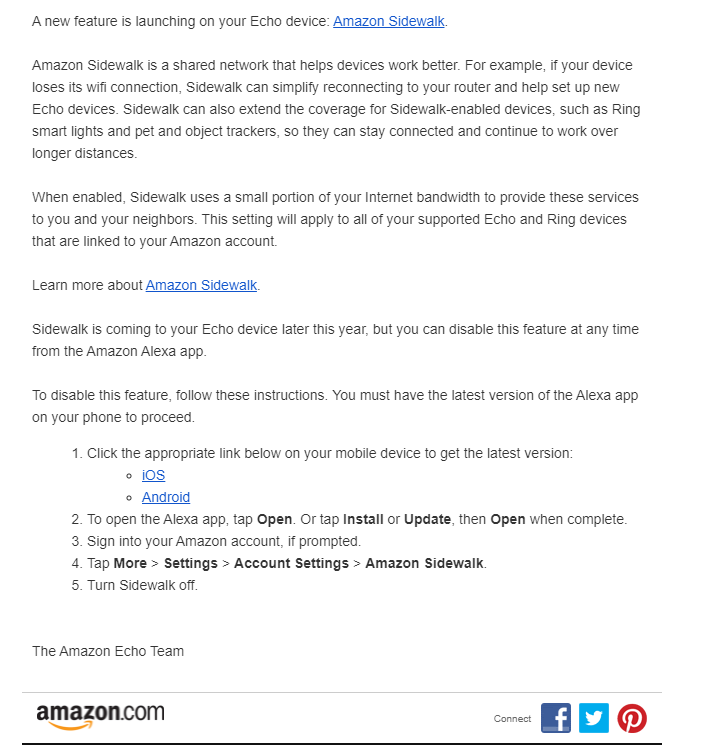
You'd probably have a hard time convincing a judge of damages given you have the option to turn this off and Amazon gave warning to customers about this functionality well in advance (November 24, 2020 is when I received the email https://i.judge.sh/right/Armor/chrome_lbf9jmauwR.png ).
> The TV does it whether you're streaming or not. You can't disable it, there is no setting to turn it off. The TV is hardwired to the router and isn't streaming anything. Even if I was streaming to the TV, it would be on my own wifi network, on theirs. There's no reason for them to control a wifi network in my house, period.
Probably just faulty engineering then, ie
  if !wifi.connected:
    wifi.enable_wifi_direct()
And bad engineering isn't usually tackled by local consumer protection agencies when they can just let the market sort itself out.
> Your disagreement doesn't hold up in terms of false advertising in that the device advertised being able to play music with your voice, not 'granular control over the wifi and other RF waves emitted!'.
I bought the device just as much for what it didn't do as what it did. It did not create its own wifi network against my wishes. Now it does. I am damaged because I have lost the ability to control the wifi networks in my home, unless I choose to take a loss on this TV and replace it.
>You'd probably have a hard time convincing a judge of damages
Again, the damages come from the cost of replacing this device with one that doesn't do what it was updated to do against my wishes. My TV isn't made by amazon, and has nothing to do with amazon, so your point about amazon warning users to 'opt-out' of being damaged by amazon doesn't matter. Amazon knows the great majority of old folks and idiots who buy their devices won't turn it off because they can't be bothered to read and 'AMAZON SIDEWALK' doesn't raise alarm bells like 'AMAZON STEAL YOUR INTERNET'.
>Probably just faulty engineering then, ie
Alternately, as you say, I'm unlikely to convince a judge that it's damage so they have no reason not to do it. They can do whatever they want and as long it wasn't disabling a feature, it's kosher. They could sell my location and browsing habits, they could check the network to see what other devices are on it and when they log in, the could do anything at all apparently.
> And this is what I mean by direct play:
My idea of direct play is an hdmi cable - its much more secure and doesnt' require any wifi at all.
Generally if you know that a product can do something is going to happen pre-purchase you can't claim damages from that thing happening, and it's no secret that the smart functionality of the device keep it up-to-date.
> In addition, an act or practice is unfair if the injury it causes, or is likely to cause, is: substantial, not outweighed by other benefits, and not reasonably avoidable.
> They could sell my location and browsing habits, they could check the network to see what other devices are on it and when they log in, the could do anything at all apparently.
Quite literally, yes, assuming you're in the United States and you check the box that specifies the terms of data collection. If you live in the E.U,, your GDPR rights mean they have to ask for explicit permission to do so.
> My idea of direct play is an hdmi cable - its much more secure and doesn't' require any wifi at all.
I'm not trying to be witty, i'm showing why devices might create their own wifi network and 'direct play' is just the name used on some TVs for wi-fi direct.
> Generally if you know that a product can do something is going to happen pre-purchase you can't claim damages from that thing happening, and it's no secret that the smart functionality of the device keep it up-to-date.
Making its own wifi network is not keeping it up to date. There's no reason for it to control it's own wifi network having to do with the keeping it up to date, that is a red herring.
If 'keeping things up to date' includes any predatory feature they can conceive of, then it's sort of meaningless.
>Quite literally, yes, assuming you're in the United States and you check the box that specifies the terms of data collection.
Terms they could update at any time to add any data, so are meaningless. Maybe I agreed to the terms of data collection before they updated the terms of data collection to new data collection. Now it's taking pictures of you sitting on the couch and selling them on onlyfans that's ok under the new terms that you agreed to forever by signing the previous terms that say they can change the terms whenever they want, and add 'features' like selling your pictures under the auspices of 'keeping your device up to date'.
That's the problem with one sided 'contracts' that don't have any consideration. They're vile and they're actively damaging. When attached to expensive physical goods it's almost certainly directly damaging.
>I'm not trying to be witty, i'm showing why devices might create their own wifi network and 'direct play' is just the name used on some TVs for wi-fi direct.
Again, it doesn't matter. I don't want it, it wasn't part of the TV when I bought it, I have no interest in a wifi network someone else controls attached to devices in my home or in my family's home, and it can't be disabled.
Adding this 'feature' has made the TV completely not ok with me. 'Keeping the device up to date' does not include make a wifi network broadcasting in my home against my wishes and outside of my control. That's some kind of dark corporate animal farm speak.


> I would not have bought it under those terms, the terms changed, and now I have to take a loss to replace the TV with something that doesn't do that.
Same as above: the terms didn't change and they aren't what it can do now; the terms are that this device might update functionality and that future change, if applied to your device, will be applied to your device under the current terms that allow it. If you don't like that, you don't have to use the device's software and you still have the right to hit the hardware you possess a hammer.
As for if you ethically should be entitled to a refund, well, how do you determine the point where someone is entitled to grievances? What if someone buys a $1000 laptop for the purpose of playing high-end games, but in 10 years game developers start dropping support for the old architecture it uses or new games simply don't run well on it. Should they be entitled to a refund? What if, on surface devices, Windows moves the start menu to the middle (a la Windows 10X), and you didn't expect that - does Microsoft now have to refund or replace your product?
Regarding:
> turns out with an OTA update the TV now broadcasts its own Wifi network and lord knows what it does on it.
That's probably a way to directly stream to the TV without a separate wifi network, or part of the setup experience (eg. connect to its wifi, type in your real wifi password, it shuts down the network then connects to your main wifi). They don't just throw extra wifi chips on their boards for no reason, so it's probably one of these.