My tldr on all this - since 1970 humanity has doubled in size - something comparabke only a couple of times in history (17C, 19C etc). A d the massive growth economically had wide ranging effects. One big one is there is a change in governmental models (autocracy to parliament, parliament to democracy)
The most obvious other effect is that land prices go up as cities grow. And 80%+ of increase in house prices is increase in underlying land.
This is of course massively unequal and negatively affects incentives for business and production.
So to change society direction create a long term (land) wealth tax (say 75 basis points a year) and plough that into education, entrepreneurship support and industrial banks greeen energy subsidies etc.
The bigger cost is land, yes, but let's not become confused into thinking high land prices are due to natural scarcity. Land is expensive due to artificial scarcity created wholly by regulation. Usually propped up by the older generations that already have their pieces of land.
Sure, dense urban areas have some scarcity, though almost all could build up.
But as I look around me in this southern california suburb, surrounded by 2,500 sq foot homes on 1/4 acre built 25 years ago that go for $800k, I can see endless empty land in all directions.
But you can't get a permit to build on any of it, because any requests to permit it are met with an army of residents near retirement that have lived at the edge of their means their entire life and so their only retirement plan is to sell their overpriced home and move to Texas.
> Land is expensive due to artificial scarcity created wholly by regulation.
This is a bit of a strawman. I suggest you broaden your perspective and don't only rely on narrow US anecdotes in order to try to explain global phenomena.
I live in Asia where there are essentially, especially from a Western perspective, zero regulations. (I've never seen a house with a smoke detector, for instance.) And land is still expensive. In a country where the per-capita GDP is under $3,000 a year, the houses in my neighborhood still cost over $500,000 and most of that is the value of land (parts & labor for building a house of that size are only about $150,000). And the city I live in has a population over 13,000,000.
"Building up" doesn't happen magically. It takes investors willing to put up tens to hundreds of millions of dollars for an uncertain payoff many years in the future. That kind capital simply isn't trivially available here.
The road to my house is wide enough for a single car -- and it is in quite poor condition. The roads flood every year (up to about half a meter) during the monsoon and "flooding" means sewers are backed up so it isn't pristine water we're talking about.
All of that infrastructure needs to be improved to increase density by "building up". In a developing country, those things are in the condition they are because the local city has an insufficient tax base to fix things in the short term. Again, it doesn't happen magically, easily, or instantly.
What's more, there are constraints to "build up". Every house in my area is already four stories tall. Because of the high water table, there's no such things as "foundations", so every house is built on top of dozens of steel piles driven 20 meters into the ground. Construction of new houses regularly causes damage to adjacent houses, due to the unstable land. Construction here is primarily of brick, which has height limits due to weight. You can use other materials but then you have additional costs of needing to import materials and not having workers with experience in it.
Sure, it is possible to take all those four story houses and turn them into eight story houses. It just takes an extra level of complexity of architecture and construction.
I'm not talking about regulations like requiring fire alarms. I'm talking about zoning regulations as well as environmental regulations that are usually well meaning, and maybe even necessary, but are more frequently used as a kudgel by local landowners to keep out any newcomers.
You can buy land in rural middle America for $2,500 an acre and build a nice house on it for $100k. And no, not the middle of nowhere. These areas have water and electric utility service as well as major highway access.
Much of Asia has a much higher population density than the U.S. Land prices are likely higher their due to actual scarcity.
The affordable housing is not in Tokyo but outside the city with a decent commute.
Also, Japanese national debt is 258% of GDP. I don't know how much incentives are put into housing but I got to imagine the government is spending it everywhere.
The housing is also built poorly and houses are rebuilt every few decades.
For a data point my wife and I live in a 1 bedroom apartment 4 and 8 minutes from 2 train lines by foot respectively, around 10 minutes from Shinjuku (central Tokyo) for about $650 - part of the trick is that unlike any place I’ve seen in US cities, my apartment is only 25m2, a size I’m perfectly OK with but would probably be impossible to find in most US cities. The density of my neighborhood is probably like 10x of my old neighborhood in SF and yet all the buildings are 1-3 stories and aside from the large number of pedestrians and proximity to several city centers, it feels smaller town than anywhere in SF.
Housing here isn’t built for the super long term, this is true - but it is built to much stricter codes than the US with respect to earthquake safety, and I wouldn’t say the typical modern American home is built to stand the test of time either.
Here they just build a lot more smaller units in much closer proximity here, and roads are much smaller which in itself probably doubles the buildable land in the city. They also have a strong transit network which means the available land to reasonably commute from is vast; you can get considerably cheaper than my rent or live in a bigger home if you lived say a 15 min walk from a train station a bit further from the center instead (similar properties to mine that are say a 45min-1hr commute to central Tokyo via bus/cycle + train can go for $350 or so, and you’d literally be living in proximity to farms (Tokyo contains a significant amount of rural countryside contrary to most people’s imagination).
I really think the American built environment is totally dysfunctional and prioritizes land speculators and motor vehicles over the people who actually live there. People here actually intend to live in their homes instead of being investment vehicles, to be a part of their neighborhoods, and to not risk their lives every time they enter public spaces. That makes it possible for working class people to afford to buy a home and for children to walk to school on their own.
Do you know to what extent the short life of Japanese housing is a cultural or geographic issue?
I've read that the Japanese simply don't like living in older buildings, so their housing stock is built with the understanding that it will be torn down and rebuilt on fairly short timescales. I've also read that the frequency of small earthquakes in Japan makes building for the long term very difficult (earthquake damage to structures is cumulative) so it's easier to build housing with a short design life.
However, I don't read a word of Japanese so I have no idea if either of these stories are accurate.
It is accurate - I live in Japan, it’s a city that’s been destroyed pretty much every few decades either by war or natural calamity - houses beyond 30 years are generally worthless beyond their land value, probably negative since the next tenant will just demolish them. People feel unsafe about earthquake safety of buildings built before the earthquake code changed around 40 years ago and generally wary of older houses in general. Plus people just want creature comforts of better soundproofing, climate control and so on.
The country is in decline but cities like Tokyo and Osaka continue to experience significant growth - it’s the large number of small rural towns that are getting eviscerated.
Land is generally expensive because infrastructure is expensive. Building plumbing systems, subways, highways, schools, etc gets directly reflected in land prices. That compounds when the cost to build even more transportation infrastructure skyrocket. Trying to build larger buildings without that infrastructure just results in pointless gridlock.
The Bay Area compounds that by capping property price increases which heavily distorts incentives and the overall market. But, don’t assume simply building more housing would actually make a significant difference long term without massive investments in infrastructure. At best it simply changes which land is valuable.
You have it almost completely backwards when it comes to the relationship between density and cost. For a fixed number of residents, nothing is more expensive per capita in terms of long-term infrastructure costs than low-density (especially single-family residential) housing[0]. The skyrocketing you speak of may occur when you look at the cost per area, but certainly not per capita, and definitely not per dollar of property tax revenue.
Basically the staggering long-term costs of maintaining suburbia infrastructure are so much larger than the property tax revenue from suburbia residents that many cities are doomed to either abandon the efforts to fend off the slow infrastructure decay, or go bankrupt.
That’s overly simplified and missing the point. You can buy a 880 home for 90k in Gilroy CA just 52 miles from Stanford. In much of the country you could travel that distance daily, but because the roads are so overcrowded it’s still cheap. I am saying the exact same thing happens just a little bit closer whenever you build higher density without building new infrastructure to support it.
Now sure like most things there is a density sweet spot. But nobody is building suburbs because their close to corn fields. It’s still the cities infrastructure that’s driving up land prices around it. Simply because that land happens to be near stuff people want.
You're touching on another important issue. Zoning that mandates homes be built away from jobs and businesses means that more density causes drastic increases in traffic. But allowing mixed use development gives people an option to cut their commutes to almost zero, if they choose, letting the density scale a lot better than if everyone has to drive.
Since most modern work is not noisy, polluting industry, the major benefit of separating residences from work has mostly gone away. But we're still suffering the costs of this form of zoning. It would be non-trivial to intentionally come up with a more wasteful way to structure our cities and towns.
Another thing to think about is that if we could allow denser, mixed used development in all the suburbs, there wouldn't be so much pressure on housing in the dense urban core of cities. If just 10% of houses in suburbs turned into duplexes, that would mean a 10% increase in housing, and it would be hard to even notice. But again, we also need more intermingling of commerce and residences, to cut down on traffic.
You end up with dense urban centers just based on the relative value of commercial vs residential square footage. An office space in NYC is often above 20/sf/month that’s the equivalent of renting a 500sf apartment at over 10,000$/month. The only way to get true mixed use zoning in ultra dense urban areas is to mandate it.
Consider from a companies perspective they want easy access to employees and other business. The dense urban core offers both, so many companies are willing to pay a premium.
Perhaps bordering on conspiracy, but I wonder how much influence the motoring lobby has on urban design and lackluster public transit investment? With the demise of trams in the 1960s in many places due to lobbying, the General Motors streetcar conspiracy to buy up public transit networks in the United States, and well known connections between motoring lobbying and governments, this wouldn't surprise me.
I'm sure there are other vested interests here, but motoring/transit is certainly one that comes to mind.
It is a real property, but misleading. It is a mobile home, so the 90K price does not include any land ownership. One must rent that separately ($760/month).
Also to add construction cost does not increase significantly by height up to 6 stories and only increases slightly more till 12 stories.
One does not need super skyscrapers in USA, but definitely needs housing units like Netherlands but with 4 to 6 stories of residential apartments and walkable neighborhoods. Unfortunately American culture will not permit this.
  Boston's Big Dig ($20,000,000,000)
  Boston's Deer Island sewage plant ($3,800,000,000)
  London's Crossrail (£20,000,000,000)
  San Francisco's Central Subway ($1,600,000,000)
  Seattle's SR 99 tunnel ($3,300,000,000)
  New York's Second Avenue Subway ($20,000,000,000)
Checking the first against population, that comes to $28,877 per person. This is hardly the only bit of infrastructure. Residents also expect water, sewage, and local roads.
So, it doesn’t matter if suburbanites where living in 40 story apartment buildings or single family homes as long as they where past the where the big dig ended it’s all the same traffic in the city center.
Infrastructure gets more expensive as density lowers. Most of the US (and France, for example) built after the 1960s decided to build stupid detached single family houses.
There is no incentive to upzone there given that homeowners who bought for cheap want their property values to go up, with no downsides for them (thanks prop 13)
Developers didn't build stupid detached homes because no one would want them, they built them because that's what most people prefer. People don't prefer dealing with noisy neighbors, etc. Almost anywhere where there is land available and it's affordable you'll have a large group of people who prefer single family homes --even favelas have single family homes. As societies become more affluent they want more independence --and your own house is part of that.
> Places where single family homes exist rarely even have the option for high density housing and, in the US at least, never have the public infrastructure to support it.
Berkeley is on the list of US highest density cities (https://en.wikipedia.org/wiki/List_of_United_States_cities_b...) and has a lot of single-family homes (definitely most by area by a large margin, and there are no high-rises in Berkeley...). The lots are small of course .
And it has, for the US, reasonable public transportation.
SF is dense but it also never the less has neighborhoods with single family detached homes too (glen park, cole valley and others built around approx time). of course it's mainly multi-family low-rise mid-rise buildings.
I think the root problem with single family homes is not their existence, but several factors:
1) They are implicitly subsidised by cities in the form of having way more infrastructure and public services dedicated to them, per-capita, than denser forms of development. Even though taxes in suburbs may be expensive, the massive amount of infrastructure it takes to support thousands of single-family homes, most with at least two drivers, means that suburb dwellers are not paying their fair share of taxes. It's like someone at a restaurant ordering a $200 bottle of wine for themselves and only being asked to pay $50 more when it comes time to split the check. In fact, in many places, single family suburbs are actually a net loss for the city, depending on the tax rates and how sparse they are.
That's also not to mention things like carbon emissions not being properly priced into the cost of gasoline. It would be much less attractive, relatively, to live far away from employment if this were fixed.
2) In many places, zoning makes it illegal to build anything BUT single-family homes.
If we could eliminate these two issues -- have people living in suburbs pay the true cost, and make it legal to build pretty anything else, then I think most people wouldn't have a problem with suburbs. But then, I also suspect that suburbs would be much, much less attractive if that were the case.
Citation desperately needed. Having grown up in the suburbs and participated in the exodus along with everyone I knew that could, detached housing is an isolating personal hell (and a pain to clean and maintain on top of it).
Places where single family homes exist rarely even have the option for high density housing and, in the US at least, never have the public infrastructure to support it.
I have lived in apartments and single family homes about 50/50 both as a kid, and as an adult, and I’d say bigger places have had an edge in terms of socializing just because it’s more comfortable to host people - but not by much.
BBQs are a great getting together activity summers (good weather). Many apartment buildings don’t have balconies or communal space fir BBQs... detached houses (or ‘plexes) make that activity easier.
It’s U shaped. NYC could build a new highway by knocking down skyscrapers or building massive tunnels like the big dig etc. At the other end, a new highway in Iowa needs to be extremely long to connect to anything useful. The sweet spot depends on a host of factors and the Bay Area ticks off several of them by having the ocean, bay, and parks, forcing a long narrow strip of development. Add in earthquakes and it’s really a terrible location for building infrastructure even ignoring NIMBY issues.
Sub-division being built by my house right now. They paid $500k for the land a few years ago. Paid $1.1m this year to get the earthworks done ( underground power, water, sewage, irrigation,etc) plus they will pave the street and do curbing. The land was the last expensive part by far, prepping it cost double.
There will be 19 lots, however he will not sell any, he will build every home on spec(ulation) and sell them himself. It's purely a profit driven decision and he will make million+, after spending years getting everything aligned and tying up capital. $80-100k in outfit per lot, plus another $100k per house. He will do quite well. However if he sold those lots and more builders were involved, we would have new housing faster.
This is true for at least 4 sub divisions being built in my town. Greed/capitalism is creating/exacerbating a housing shortage, everyone wants to maximize profits in a slow moving business, instead of just facilitating the creating of housing as efficient as possible.
The only reason that spec sub-divisions like that are profitable is all the permitting and other bureaucratic work is too burdensome for individuals. It requires economy of scale to get over that hump. Of course, there is some economy of scale with building multiple homes, buying bulk, etc. (and most of all, cutting corners that an individual home owner would never cut if they were building for themselves) but overall, it's the bureaucracy that makes it difficult for your average person.
I second this. Land is not naturally scarce. What is scarce is land near good jobs. I believe one of the major drivers of housing prices is the ratio of jobs to housing in a given area. In parts of San Francisco the ratio of jobs to houses is as high as 4:1 [1]. Nearly everyone wants to live close to their job, so the houses are priced to price out over most of the people who work in a given area. The housing becomes prices at the maximum load the top n buyers can manage. Imagine if the ratio swung the other way with an oversupply of houses, created by either relocating jobs or building new units. The prices would fall drastically until they approach the cost of construction.
Land for housing is expensive because land is a repository for wealth and housing is among the least profitable uses to which land can be put over the long term. Good urban land generates better long-term returns from commercial uses. Good rural land produces better long-term returns from agricultural uses.
By "long-term," I mean inter-generational. Land doesn't ever really go to zero. And the problem with selling land is that the seller has to do put the proceeds in a similar repository of wealth, i.e. roll over the proceeds into a different piece of land. Absent a change in investment philosophy, the seller is in exactly the same situation as before despite having taken all the risks that come from liquidating their wealth repository into cash.
Empty land is a solution to the problem of having too much money. That makes it hard to think about based on ordinary experience.
Land can actually go to less than zero. Anyone who's worked in environmental remediation can tell you how expensive it becomes. Even in non-industrial parcels, this can be a concern depending on when/how the land was previously used.
> Land is expensive due to artificial scarcity created wholly by regulation.
Growing up in Switzerland (with expensive land and housing prices), this is quite an insular point of view. Land is expensive in Switzerland at least in part due to:
- an excess of (unregulated) mountains
- regulations not allowing all agricultural land to be converted to housing (WWII is close enough in memory that it is remembered that Switzerland was not self-sufficient in food, and that this is a major problem when all your borders are controlled by a single alliance)
And it's not just fires. They're trying to turn every hillside in the area around LA into sellable land. There's mudslides, earthquakes, etc. to deal with, too!
A LVT taxes the land underneath while not taxing the building on top of it. This is opposed to our current situation in which people are deincentivized from building because it'll increase taxes.
I think taking 150 years to squeeze the "value" out via taxes feels about right - it should not be a huge rush but should be something that is inevitable and at the generational level
Not the case in my area. A lot in a great new development can be had for $150K. Same lot with a nice house is $800K. I think one reason why the land is so cheap is because of all the rules about building on that lot. Often, for instance, you don't get to choose your own builder - and you definitely can build modular.
I think that far and away the biggest cost for housing in the West is money. Yes, interest rates are at all time lows. But that means loan amounts have skyrocketed in comparison to incomes. That has impacts across the economy.
The West has very dense development. Most of the US isn't like that.
Where I live, land has to be 1/3rd the value of the home. Want a bigger house? You have to have a bigger plot or the bank won't lend the money because the value ratio is off.
It's honestly refreshing to see such a clear case of Silicon Valley hubris out in the wild again. These had started to die down recently. Neither founder has any experience in real estate or construction. Their entire premise seems rest on pretending that manufactured housing doesn't already exist.
I go to their "Our Solution" page and find this at the top:
>Blokable creates prosperity and equity in communities by disintermediating the traditional development process and providing a vertically integrated solution to create housing at scale. Our solution is a new paradigm in development, enabled by a new building system and technology.
If I didn't know any better I would think this company was generated by GPT-3.
Look a little deeper. They're creating smart multifamily rentals at market rates but including a few affordable units in each building. The affordable units are not an act of altruism but a regulatory requirement. You can't bring new multifamily to market without adding affordable units as well.
Endless one-offs? Have they ever walked through a recent development by any of the well-known residential construction companies? It's all three or four of the same!
Also, have they ever walked through any European residential development of 50 years ago? People used to contract an architect for single-family dwellings then, and they would get something that was acceptable and fit their needs.
You'd be surprised by how many differences there are in new houses (or other dwellings) that were built off of the same blueprints. These are usually small things but if you live in one of the homes, it is noticeable.
I lived in a midrise condo and was the first person to move into the building so I had pretty run of the entire building for a few weeks. All of the units in any given stack of units were meant to be identical but they weren't. Sometimes a cabinet over where the fridge was to go would be missing or maybe the protective lens over the light fixture in the shower ceiling. Walls that met at a non 90 degree angle sometimes had a sharp corner, other times a smooth one, and some other times a beveled corner. Most of these difference were too small to have been customizations. They were from different work crews interpreting things differently. They were from the materials on hand being slightly different between days when the interior of different units were worked on.
In my last house the neighbor across the street had the same floor plan as us but once again, lots of minor difference of little consequence but noticeable. Most were obviously from the differences in materials on site and the quirks of individual workers.
I absolutely agree - I call this field-not-yet-factory. In a factory those sort of differences will be autoamted away In the "field" they are left to the skill, discretion, whatever of individual workforce.
Frankly this costs the construction industry a fortune - work done substandard has to then be corrected later at great expense, so the driving goal will be towards a "robot construction worker" - but getting there you can imagine is problematic.
Pre-fab buildings have existed for a century by now, and they do work. However, they have a negative market reaction in most locales, and the cost saving again is not huge. so here we are.
You're concentrating on the output (what the building looks like and what people living in them think), but the actual opportunity is on the input side: what components go into those buildings, and the construction company margin achievable if they can be more standardized and mass-produced.
Indeed, I've been watching an apartment building go up, while on my daily walk. The whole thing is coming in prefab modules on trucks and being assembled on site.
Well, those components are too small. I'd probably like to go full-sears and just have to attach the front and back half of my house together on a foundation.
When you're done handwaving, since you've hit the nail on the head (so to speak), perhaps you can expand on you think they are too small and what the optimum size really is.
I do think there is something to be said here about variances in city, state and federal ordinances and code. Ideally there would be only 1 federal code to which to build to but due to regional differences I think 1 code for any given region would suffice.
I'll add that getting city permits and what not is also a nightmare and it really shouldn't be. If there was a well equipped federal agency to do this through we'd all be better off.
Contractors are licensed at the state level. Most states already adopt model building codes recommended by national organizations. There is generally little variation in building codes between local governments within each state.
The last thing we need is more federal government overreach. Nothing in the Constitutional gives the federal government the authority to control building permits.
I'm not saying I necessarily agree, but I think there's at least some argument that building codes/permits may fall under the general welfare clause of the Constitution
Regional codes make sense. Florida houses don't need to be ready for earthquakes, California houses don't need to be ready for Cat 5 Hurricanes (although more cat 5 or 6 in the walls would be nice).
Federal permitting sounds like a nightmare too. If you need a variance, it would take an act of congress.
I would expect that a lot of the variations in the code across different areas would be related to climate and geographical differences. Some areas require cyclone/huricane rating, others need to deal with earthquakes...
Know all of those small tract homes built during the 50s, 60s, and 70s that few want to live in now? That's a good approximation of what I think they're selling.
The postwar housing was designed to handle the baby boom. It was cheap to build due to uniformity and it largely succeeded at its purpose. We had a huge middle class as a result.
You can have speed, volume, or quality, just pick two. In the postwar period we picked speed and volume. It wasn't a bad choice given the circumstances.
One comment buried in this thread manages to note what I think is the key error here.
The article claims that the parts for building are not sufficently standardized. That's certainly a claim to make, but you can't just accept that as-is.
The parts for building almost housing stock in a given country are almost completely standardized (they may vary from country to country, of course). What the authors mean, but do not say, is really "the standardization has occured only at the smallest scales".
Studs, joists, shingles, plumbing, electrical, block work, window and door sizes, plumbing connectivity, and so much more are all more or less completely standardized. There are options to break with the standards and get (for example) a one-off doorway sizing.
What the authors want, but do not say, are modular components of larger scale: entire walls, or entire rooms, or entire buildings that one can put together.
They might be right to want this, or they might be wrong. If software was any useful evidence, they're probably wrong. But this is not at the same thing as saying "things are not standardized and should be". The small scale components of buildings are extremely standardized in most industrial nations of the world.
There's a truism in architecture: "Buildings are built for people." Not to be works of art or cultural enhancements, but to serve a need.
I think it applies here, too. A home is one of the most personal possessions anyone can own. Although you can make arguments all day long about efficiencies in design and mass production, I think just about everyone in the world who owns a home would much rather have one designed to fit them and their purpose, not one made from large scale standard parts.
I say this as someone who has a number of unusual things desired in a home, and who has had a lot of difficulty deviating from "standards" for home use. The efficiency benefit of standardization is also a standardized jail for people who want to do something different.
There's a place in the market for cookie cutter homes if costs must be reduced to minimum or construction time must be minimized, but in pretty much every other instance, people want the opposite of what this company is selling.
> Housing development is antiquated and the only group benefitting is the real estate development and building industry, who in fact have every incentive to restrict the supply.
There is another group benefitting from high building development costs: all current owners of real estate. If new housing would become cheaper, existing property would also loose value. And there is enormous amount of money in existing real estate.
Many business and individuals would be loosing a lot of money if society/politics would really create cheaper housing, i.e. by enacting policies that increase density, lower cost of land, or limit rents.
I think the fundamental force of existing valuations working against lower prices is much harder to overcome than high construction costs.
It’s one of the reasons that no one can stay on top forever. Neither companies nor countries. Too many entrenched interests get too much power and then it’s over.
Instead of talking past each other (“millennials can’t afford houses!” Vs “boomers were counting on their house for retirement”) we should focus on long term planning with gradual changes that people can plan for.
Unfortunately in a huge democracy it’s very hard to stick to any long term plan like that.
Apparently "reimagining housing" means inventing the mobile home. How innovative. I live in a double wide, and wish it was many times cheaper than a site built house but sadly not. The car analogy doesn't fit. It was built in a factory and is cheaper but has definite limitations. It sure isn't a slam dunk replacement for one-offs.
Interestingly, the soviets were on a mission to provide housing for every person in the country. To be successful, they knew that bringing down cost will be key. This then led to entire cities and provinces to only build 1 or 2 floor plans.
I think the notion that "one offs" increase cost is really not nearly as big of an added cost as the article makes it out to be.
I've worked on building homes and monitored the process quite a few times and while it might look chaotic to someone who doesn't build stuff the guys who do it for a living are very efficient.
And the notion that homes should be mass produced from a template sounds awful to me. I think where we've blown it with home design really began in the `80s with the boom of "McMansions". They're expensive to maintain and very inefficient.
In the past decade I've seen some very cool smaller home designs (as well as "tiny" homes) so, personally, I think we're doing a lot better now than we were 20-40 years ago.
This is more of a sales pitch for their company than anything else, and is mostly misleading or just plain wrong.
Talking about the housing crisis, the cost of the physical building is wayyy down in the list of concerns behind land value, zoning, permits and lots more.
Everyone is promoting adding more density but I see no posts discussing quality of life with those changes. Adding a 20 story building to a neighborhood of historically single family homes impacts infrastructure, traffic, noise, etc. Adding to the fact that there are people that don't want to live in attached homes, apartments, etc.
I remember watching a video recently where someone was arguing for us to go back to timber and beam construction because it was substantially simpler than the stick-constructions we are doing now.
Basically a lot of people agree that stick construction is a shit show, but nobody agrees how to fix it.
It always has amazed me how hard it is to run an ethernet cable in a finished house, let alone a water line or a drain. And waterproofing a bathroom the way we assemble them is essentially a joke. Which puts me in a third category of people wanting something different.
It's not like a finished area was so much easier to modify in the past. Plaster and lathe walls tend to have a much smaller cavity than drywall, in the same cross-section. Plaster keys take up a good amount of the space.
What I find interesting is how there used to be pre-measured kits for constructing houses, so in that respect we've gone backwards.
I’m trying to remember. I believe his premise was that post and beam are the load bearing elements. The skin can be its own structure, instead of being built into the outside of the wall, and therefore you aren’t puncturing it every eighteen inches. And your insulation isn’t similarly transited by a conductor.
He was calling for preformed exterior segments you bolt together.
They need to be made out of something unless you like a very open plan. In the past they might have been made from wattle and daub, or you could use studs, paper, whatever you want since they're not structural.
People with money can buy houses, is there much interest in serving the rest of the population? There is already way more empty houses than homeless, so the problem is not is not having enough housing. No force strong enough to solve housing crisis is sees housing situation as a crisis, having affordable housing — that would be a threat.
As far as I can tell everything is pretty much standardized these days, not sure what inefficiencies these guys imagine. I live in a college town with a ongoing huge boom in student housing and I can say for sure that the process is extremely efficient.
Want something personalized and craft-built? That's where you're going to spend some cash.
This article seems so strange for me, as my experience is that out-of-the-catalogue houses are the first choice now (at least in EU). This is perhaps true here in Denmark, where IMO 90% of houses are catalogue houses that have been customized. That means that a variety of houses on offer from same supplier share same prefabricated walls, same type of insulation ect.
Same is true for Croatia, where people usually built hollow brick rohbau (walls+roof) first according to a custom design and then settle in on everything else.
Considering the difference in price between roughly the same house in Denmark in Croatia, I would say that manual labour is still a big cost driver, so most of cost reduction will either come from even more modularity (deliver an entire bathroom) or automatization.
The solution is to build dense housing (min. 20 story towers) with mixed commercial in the lower levels on cheap land (<1/100th the cost of city land) within 50 miles of cities and then run Boring Company tunnels to your new town at a cost of $1mil/mile. Commute time of 10-25mins. Total cost is roughly $1.8bil for a town of 30,000. Each of the condos goes for $150k. That's 12% of the price of a condo in San Francisco. Also could build down underground 10-15 stories. Unsolved problem is low-cost infrastructure (water, sewage, power). Whatever couldn't be built on site could be piped in through through additional tunnels.
This would completely change housing prices in cities. If SF has around 700k residents and say another 700k people who want to live here or commute in each week, it would take 23 of these towns to accommodate demand: $46bil investment that would probably payout 25% within 5 years of construction start with all units sold, commercial leasing, naming rights, etc. (Large assumption is people would want to live in these towns). San Francisco housing prices would probably drop at least 25% in 5 years.
Just like Matatu's of Kenya (http://infinitedictionary.com/blog/wp-content/uploads/2016/0...) each town would be known for its thing: TownA is known for its Opera House, TownB is known for its Basketball Team, TownC is known for its amazing Foodie Scene, etc.
A successful 'Town' model could even be franchised like Burger King, repeated all over the USA or World within 50 miles of existing major cities. If you were the owner of a successful franchise, and optimized your margins (solving the electricity problem with solar panels or a cheap nuclear micro reactor), you could have 200% returns on each $1.5bil project. Even a couple of towns completing each year could be worth billions. And they would probably be less complicated to build than the average Tesla Terafactory, once the first few had been built.
The summary: the hard part of tunnels and people was what to do with exhaust gases. That's solved with electric cars. The tunnels will probably pay for themselves or at least break even.
In 5-10 years, its likely that most major freeway projects will have a very difficult time getting funding as tunnels will be cheaper to build and much much much cheaper to maintain than roadways. And existing investments in tollroads or bonds for roads will be selling for pennies on the dollar.
The cost per mile may even get as low as $100k/mile. At that price point, individuals could be drilling their own private tunnels.
As a comparison against tunnel prices now, when Google Fiber tried to lay fiber optic cable in San Francisco a few years ago using shallow trenches and not full tunnels, the full cost was estimated to be in the $100's of millions for the backbone and low billions including all house hookups. https://sfbos.org/sites/default/files/FileCenter/Documents/5...
And San Francisco is a tiny city: 7 miles by 7 miles. Once the Boring Company gets prices down to $1mil/mile, you could make the same Fiber backbone with 3 tunnels N-S and 3 tunnels E-W for 6x7 = $42million - a little more than 1/10th the quoted cost.
More comparisons: the Alaska Way Viaduct project (SR 99) in Washington State cost >$3billion and was only 2 miles long and took 12 years. The cost was $1bil/mile - so Boring Company will be 1000 times cheaper. https://www.wsdot.wa.gov/projects/viaduct/budget
Overall point: There is a potential solution to the housing crisis for almost every city. It is too early to tell if it will work. But it looks promising.
Steps:
1) Build electric cars (exhaust gases in tunnels kill people). (Completed 2020 - Tesla)
2) Build tunnels that are 1/10th to 1/1000th cheaper than current technology. (In Progress - Boring Company)
3) Build tunnels that connect cities and the infrastructure to make city to city commutes through a tunnel but walking on foot using tunnel bus-like vehicles, easy, cheap and safe. (In Progress - Boring Company)
4) Build a test town of 1k-10k condos and connect to a major city with Boring Company tunnels. Initial cost of a test would be $500mil to $5bil. (Not started - ?)
5) Reduce the cost of building towns through 10X or better infrastructure improvements and develop a franchisable business model around towns.
6) Franchise the towns.
Result: Housing supply goes way up near where people want it right now. NIMBYs can't stop it. Investors may lose their shirts or make massive profits.
Advantages over other solutions: This only works if the business model works out. It leaves the politics of land-use within cities almost completely out of the picture.
Disadvantages: Its never been done before. It will cost a LOT of money to test it. The investors must be in it for the longish haul: 5-10 years at least.
I understand how reducing tunnel diameter by half reduces cost by a factor of 4. I can even imagine that using electric motors, batteries and few other optimizations might give an energy efficiency of 2-3x compared to current TBMs. However i find it difficult to believe that tunneling costs will reach 1 million $/mile. The different types of strata, energy costs, use of advanced tech like lasers/supercapacitors in parts might help.
From 10:22mins in the video:
* Increase speed: automated segment erection and logistics; simultaneous mining and installation of reinforcement segments; 3X increase in power for TBM; continuous dirt removal; modified cutter design. Probably leads to 10X faster.
* 13:12mins: Decrease costs: onsite integration, reduced diameter of tunnels, electric locomotive, sell bricks.
15% of costs is dirt removal. Selling bricks for $0.10ea pays for dirt removal. 15% savings right there. (Price comparison: bricks cost $0.25 retail at Home Depot)
So the test tunnel cost $10mil/mi but can only put through 1/4 the area. So to balance against existing tunnels at $1bil/mi lets round up to say equivalent throughput for mass is $50mi/mile - assumes people throughput happens at the same speed of current mass transit - 45mph. Hyperloop tunnels will go much faster than that. But even non-hyperloop electric cars can go 90mph with self-driving - so double speed = double mass transfer and half mass_transfer cost per mile per time unit.
So kinda apples to kinda apples comparison of the very first tunnel Boring Co made is $50mil/mi versus $1bil/mil in LA for same mass throughput at same speed. They are already 1/20th the cost. Even if I am way off, by a factor of 10, the Boring Co is already HALF the cost of existing tunnels with their very first attempt in Dec 2018. The next update will put them even further along.
Agreed. The cost for underwater tunnels will be much higher - especially initially. Let's say they are 100X higher cost at $100mil/mile - that is still 1/30th the cost of a current tunnel in San Francisco at $3bil/mile. But the Boring Company is already designing for air tight tunnels: 'vacuum-sealed'.
"TBC’s current tunnels are designed and built in preparation for their eventual transition to Hyperloop."
"Hyperloop is an ultra-high-speed underground public transportation system in which passengers are transported at 600+ mph within a vacuum-sealed tunnel. Whereas Loop is used for shorter intra-city routes, Hyperloop will be used for longer inter-city routes."
I think you probably need to read Atrios (at least) on Boring Company (along with most of Elon's other stuff)
eschatonblog.com ... he probably has tags.
Suffice it to say that to say that Boring Company is getting closer to any of their stated goals is like saying that a monkey climbing a tree is closer to interstellar travel.
Did a site search "boring site:eschatonblog.com" and read through top 30 or so hits. Didn't see any arguments that Boring Company is fundamentally wrong and can't succeed through the limitations of physics.
Valid criticisms:
* Boring Co is moving pretty slowly.
* There are specific problems that have not been solved yet related to station design, the mini bus people mover vehicle (12 people) has not been made yet, self-driving cars aren't real yet, the actual Boring machines are only on version 3, the automated tunnel wall mfg and assembly machinery has not yet been built.
I agree that there are many assumptions (which could be incorrect) that need to be solved for the city to city test to succeed:
* Cheaper Station design for passenger and cargo load / offload.
* 12 person walk on / off bus mover vehicle design, manufacture.
* Self driving.
* Faster elevators and probably bulk elevators to move vehicles between levels of tunnels.
* Faster Boring machines
* Tunnel wall assembly machines from dug out dirt.
* Automated tunnel wall assembly.
The first solutions to these problems will probably be pretty crappy. But they will improve rapidly.
Godot (1X speed) was a straight up purchase of existing tech. Linestorm (2X speed) was partially upgraded from existing machinery from other companies by Boring Co. Prufrock (2->10X speed?) is the latest and version 3.
My guess is they need to get up to version 10 or more for a chance to beat Gary the snail. They still have a long way to go before they have their own machines 100% built by Boring Company that are much cheaper and faster.
Also, it doesn't look like there is much progress yet on the brick making machines. Or the automated tunnel assembly from bricks made from local dirt. The ideal system has definitely not been assembled yet: Boring machine -> dirt into wall sections -> wall sections assembled into tunnel wall.
So yes, there is a long way to go yet. But these are solvable problems that the team is working on.
After that, it may be time to work out the details of building an ultra dense city on super cheap land and try to reduce the costs of construction and maintenance of city infrastructure: water treatment etc.
The selling point of a $200k condo with access to pools, gyms, etc with all the basic stores like dry cleaners, grocery store, restaurants a short walk away in your town/city AND a 10-25min tunnel ride to the big city may be hugely attractive for many people. Plus if you want to go ATVing or cherry picking or horseback riding or camping, you can take a 10min trip from your town right into the countryside because you will be there already, in the countryside.
If an average restaurant worker or entry level school teacher works in San Francisco right now, they may earn say $60k-$90k and pay 33% taxes - max $30k. Factor in rent at $30k (1bedroom is $2500/mn), and basic living expenses of $15k and that person is saving max $15k/year. The average condo in San Francisco is $1.2mil. So it would take around 8 years to save for 10% down payment or 16 years to save for a 20% down payment.
Contrast that with a condo for $200k a 20min commute away. You would have a 20% down payment in 3 years.
It takes longer than 20mins to drive across the city without traffic right now. During busy times it can 60 minutes to drive from the Golden Gate bridge to SOMA. You can literally walk faster than cars in San Francisco.
The selling point: If you want to live in a big city for its job and cultural opportunities but can't afford it, then this option is 10X cheaper.
That makes this option very attractive. Especially if you choose a town franchise that fits who you are. You could join the Tech Town if you are into technology. Or Scientist town if you want to do University research. Or the Middle Ages town if you want to ride a horse and a visit a Blacksmith.
And if you change your mind on who you are in a few year, and one of the other 20 towns near a big city look attractive, you could move there. Say you want to party in Mini-Vegas town for your early 20s but then move to University town in your early 30s to get educated. That could be possible.
Not all, perhaps, but more than you might think. If you want to see for yourself, go on Zillow and check out prices for empty lots vs. nearby lots with houses on them in different areas. When I just did that, the price ratio seemed remarkably stable anywhere near even low-demand cities. You have to get pretty far out in the sticks before it falls apart, and almost by definition that's a low percentage of homes.
So I’ve been doing a lot of this recently because I was applying for jobs across different areas of the country. It seemed to me that as long as you stay away from the coasts or major cities, land can be had for 20%-30% of the built value. Just anecdotal of course
How they're built has nothing to do with the immense complexity of building them, it has to do with the land. Everything about a house is tied to the land it sits on. The regulations, the building codes, the architecture, its particular uses, etc. None of that's going to get walked back because local communities won't let it.
I think the best this company can do is to become a sort of SquareSpace for housing. But we've had pre-engineered houses before (remember the Sears Catalog homes?). And we have commoditized housing now, they're just called trailers. You could totally scale-up houses by stacking trailers (that's roughly how wooden homes are built today) but either nobody wants it, or nobody's been able to scale it and make it appealing/significantly less costly.
But I wish them good luck! The sooner we can get city councils to start allowing "unusual" home zoning, the better. I want my Tiny House permit, god damnit.
Each piece of land is a one-off. Its non-fungibility makes it real property. Buildings are built upon foundations. Each foundation is site built. Each site must be prepared first.
Building is always one off because of this. It’s why a car parked on a plot of land is not a building. Even less of a building than a tent.
Yes, like that guy in Tennessee who didn't pay the firemen and complained that they wouldn't show up when his house was on fire. If you want civilization, pay your share. (Corollary: be extremely wary of lowtax types and their vision of society!)
"Some people have claimed that the word 'real' in this sense is descended (like French 'royal' and Spanish 'real') from the Latin word for 'king'. In the feudal system (which has left many traces in the common law) the king was the owner of all land, and everyone who occupied land paid him rent directly or indirectly (through lords who in turn paid the king), in cash, goods, or services (including military service). Property tax, paid to the state, can be seen as a relic of that system, as too is the term fee simple. Some say this derivation is a misconception; but that is countered by evidence that the earliest meaning of 'real' in English included "Of, relating to, or characteristic of a monarch, royalty, or (by extension) the nobility, esp. with regard to power, wealth, or dignity; (also) befitting a monarch."
Sorry, I must have copied from a rabbit hole started from the original link you provided. It's under the entry for the etymology of the term “real estate” as opposed to the “real property” link you provided:
Blokable is promoting itself as providing affordable housing but their buildings largely consist of market rate housing units and a percentage of affordable housing units that are compulsory -- not an act of altruism. Large cities already have requirements, or are actively developing requirements, for developing affordable housing along with market rate housing. Market rate tenants subsidize affordable housing tenants. Cities use lottery systems for the affordable housing units to prevent political insider housing opportunities, but those lottery systems aren't being audited by trusted third parties. :)
Putting the PR spin aside, the company is doing phenomenally well with execution and development across many silos. I respect the hard work.
Customization/design premium is insubstantial compared to land price most of the time. That said I can see snowflake designs with no consideration for functionally leading to excessive environmental costs. Ideally the default typology should be an extremely efficient and economical net-zero rectangle oriented for maximum solar gain. People should recognize how much additional "extravagance" goes on in your typical construction, and maybe reel back a little. There should definitely be a mcmansion extra roof / unnecessary geometry tax like old window taxes.
Levittown is interesting because all of the houses were cookie cutter copies of each other when built but if you go look at it now, the houses vary a great deal. Some of the difference are cosmetic, such as different paint colors. But there are bigger differences in who added on a large front porch, a great room, extra bedrooms, or expanded out the kitchen to double the space. Add in differences in landscaping and it's not quite the poster child for bland tract housing that it once was.
I took a tour of Pompeii a couple years ago. Two thing that struck me (beside just amazing) was a) housing hasn't changed all that much in 2000 years, and b) modular housing (of course made of stone).
Modular housing has been a thing for a very long time. So has extreme opulence.
I remember an episode of an early 90s “future show”, Beyond 2000, I think, talking about building custom homes in Japan from pre-fab modular building blocks containing all the electrical, plumbing and mechanical built in. What’s new is new again?
Paying more for unique houses could be a rational strategy.
Unique houses have higher resale value compared to tract houses because there is more market differentiation. Try selling a condo. It's hard to ask more if two or three other identical condos in the building are also for sale. Then try to sell a single family house in a neighborhood with diverse housing. You can charge more because you might find the buyer who really loves whatever is particular about the house.
So if you pay more and sell for more it's all a wash. Unless of course the house price is so high that a down payment is unattainable. I would call that a market failure in most cases (Manhattan is an exception). Such a failure is probably symptomatic of political intervention in the market, usually in the form of restrictive zoning and development practices.
By all means we should try to standardize and automate home construction. But uniqueness has value to many.
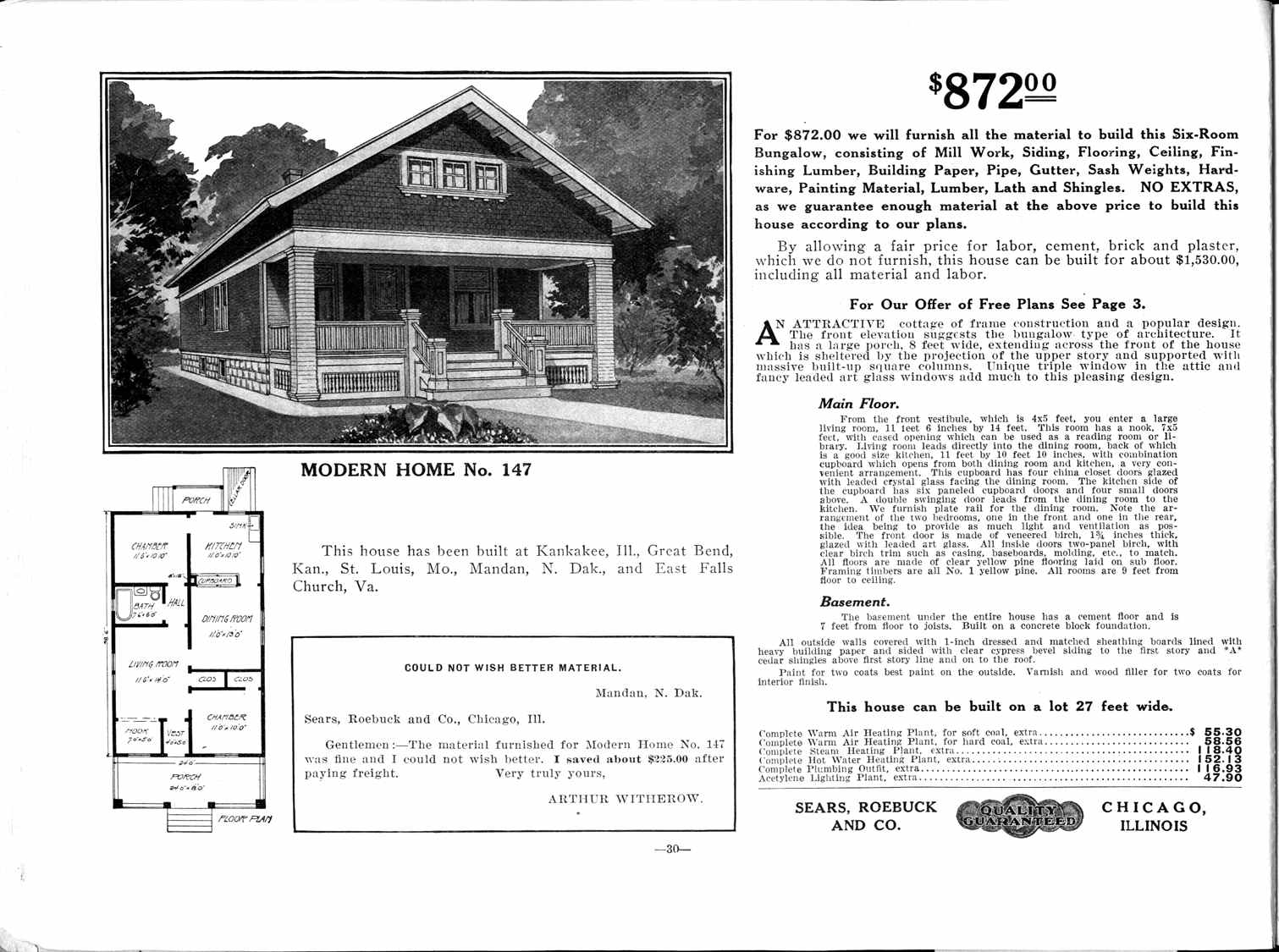
The Model 147 is 900sqft and cost $872 for materials, estimated at $1,530 with labor.[0] Adjusting for inflation from 1914 to 2020, that is about $22,000 for materials and 40K with labor.
Looking at 1913 US national labor statistics, the average baker in 1913 San Francisco worked 54 hrs/wk and made $0.46 per hour for an annual wage of $1,291[1] (or 33K in 2020 dollars)
The median baker in 2020 California makes 36.5K/yr [2]. The cost of new housing construction is $220/sqft[3], or 200K for the same size house.
Yea I think it did briefly bc I’ve seen several sears homes around my town and they’re pretty stylish compared to more recent homes. I wonder what happened
What bothers me is that every year we get new, lighter, cheaper, faster, building materials, every year we improve construction processes, every year we're building more and more floors in same period of time and yet still appartments and houses are getting more and more expensive despite of all these improvement's. Can someone pls explain me how's that possible? Am I overestimating improvements?
"so many people" ... no, just enough over the numbers for what's actually available to drive prices up. Alternatively, just enough with just enough money (in hand, or leverageable) to drive prices up.
The whole world is not rushing to places in the US with insanely high property prices. Just enough people to keep those prices up (and maybe even still rising).
What if the high paying jobs spread out to less-dense places? Then people could get both things they want: a good job and not being on top of each other.
Please google "affordable housing crisis united states". The first 40 or so stories paint a decent enough picture so I won't link them here.
> Housing prices are high because so many people want to live in highly desirable areas with high paying jobs.
Young middle class white people can't find a house in San Francisco, sure, but that's not the major problem. Most of the housing problems are in places that are not desireable, and there are a myriad of different causes.
> There are plenty of less desirable places with cheap housing and ok paying jobs.
Not even remotely enough to fulfill all the low income housing needs in the US. Even if there were, people wouldn't be able to go there anyway, because they don't have disposable income, and there's no "let me uproot your life with $20,000 you don't have to pay back" fairies flying around.
and massively inefficient. the roads, the driveways, the garages, garage doors, the walkways, the easements, roofs, the eases, hvac systems, water heaters, the plumbing, the extra windows, the extra walls, the extra electrical/phone/cable/internet, and more... all done over and over. might as well have built one huge building and shared all those redundancies and infrastructure costs, while maximizing space and energy efficiency.
Whenever I visit Prague, I can't help but notice the stark (pun accidental) difference between the Communist-era concrete boxes and the beautiful architecture of the periods pre-dating it.
It's not that bad when you employ a competent architect. Much of Lisbon was built under Salazar in the 1960s, it doesn't look half bad and 50 years later it's holding up extremely well.
> Much of Lisbon was built under Salazar in the 1960s, it doesn't look half bad and 50 years later it's holding up extremely well.
Lisbon has construction spanning from Roman times all the way to today. Most of the downtown was rebuilt after an earthquake in the 18th century.
Besides public buildings, there were a few residencial neighbourhoods and social housing built by Salazar's regime, implying that 'much of Lisbon' is his legacy is factually wrong.
Moreover the "Estado Novo" architectural style promoted by the fascist regime was meant to bring back themes from traditional portuguese construction, with a lot of masonry embellishments. This is the opposite of the monotone pragmatism of the soviet blocks.
Sure the both Lisbon and Porto grew and Salazar enforced a de facto architectural style, but the regime only built public buildings and some social housing.
Perhaps this is an English-as-a-foreign-language thing but to me "under Salazar" implies that the regime ordered, and payed for, most of the construction in that era which is not true.
Not a native speaker either, but to me "under Salazar" would mean during his era and expressing the era's spirit. As you say, the city planning and architecture certainly bears the stamp of the Estado Novo, even though the government didn't pay for most of it.
Given just how hard I’m having to work to keep any roof over my head, I really don’t care for the ‘quality’ argument. Australia has become so overpriced that literally nobody in the next generation is likely to own a home. Try building a successful country when most of your citizens are serfs.



.jpg)
See Josh Ryan Collins https://youtu.be/RX-AzKgUEWk
https://www.ft.com/content/ffa66898-fe7b-11e6-96f8-3700c5664...
My tldr on all this - since 1970 humanity has doubled in size - something comparabke only a couple of times in history (17C, 19C etc). A d the massive growth economically had wide ranging effects. One big one is there is a change in governmental models (autocracy to parliament, parliament to democracy)
The most obvious other effect is that land prices go up as cities grow. And 80%+ of increase in house prices is increase in underlying land.
This is of course massively unequal and negatively affects incentives for business and production.
So to change society direction create a long term (land) wealth tax (say 75 basis points a year) and plough that into education, entrepreneurship support and industrial banks greeen energy subsidies etc.